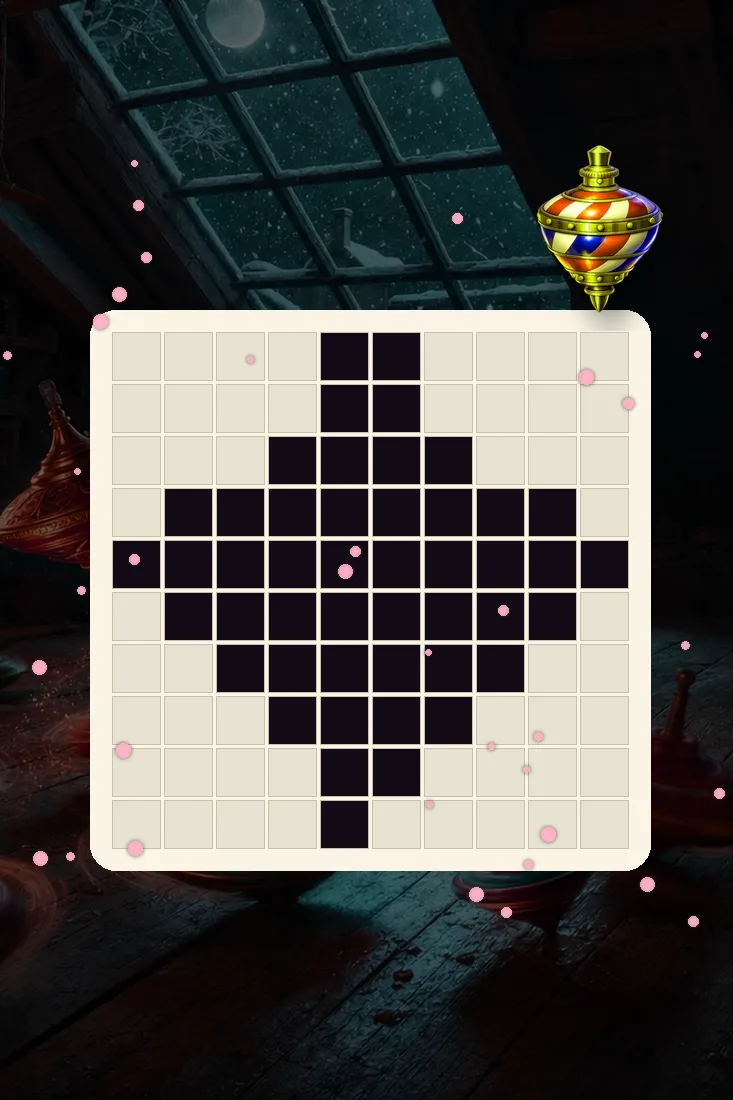
Workbench Blueprints is a nonogram, sometimes called a picture-grid or paint-by-numbers logic puzzle. Each row and column has a short list of numbers beside it. A clue of 3 1 means that line contains a run of three shaded cells, then at least one gap, then a single shaded cell. Put every row and column together and only one picture fits.
The pictures are drawn from our toy icons. The game reads each toy’s outline, turns it into a grid and hides it behind the clues: the sledge penguin, the robot dog, the water tower and nine more. Puzzles come in 10 x 10 for a gentle start and 15 x 15 for a meatier session. When the last correct cell is shaded, the grid gives way to the toy in full colour.
How to play Workbench Blueprints
- Choose a toy blueprint and a grid size of 10 x 10 or 15 x 15 from the start screen.
- Read a row or column clue and shade the cells you are certain belong to its runs.
- Switch to cross mode and mark cells that must stay empty, so you never second-guess them later.
- Drag across several cells to fill or cross a whole stretch in one stroke rather than tapping each.
- Keep working line by line until every clue is satisfied and the full-colour toy appears.
Workbench Blueprints controls
Getting better at Workbench Blueprints
- Start with the biggest clues. A run of 8 in a 10-wide row must cover the middle cells, wherever it sits.
- Add up a line’s numbers plus the single gaps between them; if the total equals the width, the row is solved.
- Cross out empty cells generously. Each cross turns a vague line into a short one with fewer possibilities.
- When a line feels stuck, move to the columns that cross it; their clues often unlock it for you.
- Watch the clue highlighting as you work; it shows which line you are on and keeps your place on big grids.
From toy outline to logic puzzle
We did not hand-draw a single grid. Instead, the game takes each toy icon, shrinks its outline down to a block of squares and keeps the cells where the toy is solid. That gives us a picture with a recognisable shape, and the clues are simply counted from it. Shapes that came out with too many empty rows were adjusted until every grid felt worth solving.
We chose motifs with strong silhouettes for exactly that reason. A peg top, a semaphore signal or a passenger carriage reads clearly at ten squares wide, which means the moment the picture starts to show through, you get a small jolt of recognition. That jolt is our favourite part, and it often arrives around halfway, just when your attention needs a nudge.
Why we never ask you to guess
A good nonogram can be solved with logic alone. You should never have to shade a cell on a hunch and hope. Our grids are built from real outlines and checked, so if you feel stuck, there is a line somewhere that you have not squeezed hard enough yet. Usually it is a column you skipped because it looked busy.
That is what makes the 15 x 15 grids so satisfying. They look daunting, but they break down the same way the small ones do: a big clue here, a run of crosses there, and slowly the edges of the toy appear. Finishing one feels like assembling a model from a careful set of instructions, which suits a workshop rather nicely.
Questions about Workbench Blueprints
There are twelve toy motifs, and each can be played as a 10 x 10 or a 15 x 15 grid, so a toy you solved small becomes a fresh challenge at the larger size.
Fill shades a cell as part of the picture. Cross marks a cell you have decided must stay empty. Crosses do not change the answer, but they make your reasoning much easier to follow.
The shaded silhouette is replaced by the full-colour toy it was built from, so you see the robot, penguin or locomotive you have been uncovering all along.