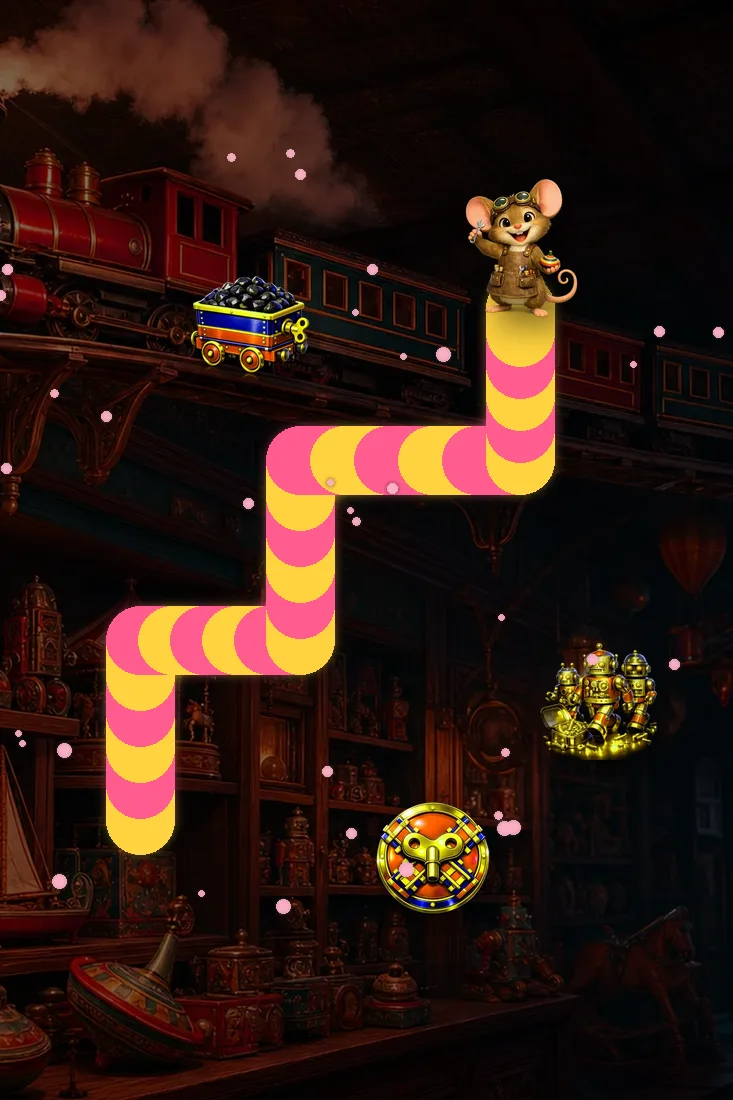
Rafter Railway is our take on the trail-steering game everybody remembers from old phones. You guide the head of a line around a grid laid over the attic floorboards. It moves on its own; you only choose which way it turns. Each part you collect makes the line longer, which is lovely for your score and less lovely for the space you have left to manoeuvre in.
Three toy parts appear on the floor. Screw tins are the everyday find, worth one point. Coal wagons turn up less often and are worth two. The crossed-rails badge is rare and worth five. We made the movement smooth and gliding rather than hopping from cell to cell, so turns feel as fluid as a model train taking a curve.
How to play Rafter Railway
- Choose Classic or the wrap-around mode on the start screen and press Play to set the line moving.
- Swipe, use the arrow keys or WASD to turn the head up, down, left or right.
- Steer onto screw tins, coal wagons and rail badges to collect points and lengthen the line.
- In Classic, keep away from the walls and your own tail, because touching either ends the round.
- In the wrap-around mode, slip off one edge to reappear on the other, but avoid the water towers.
Rafter Railway controls
Getting better at Rafter Railway
- Hug the edges early on in Classic; a line that runs around the outside leaves the middle free for later.
- Turn one move before you need to. The line glides, so last-moment swipes can carry it a cell too far.
- Leave a rail badge if reaching it means threading through your own coils; five points are not worth the round.
- In the wrap-around mode, use the edges as shortcuts to reach far-off parts without crossing the board.
- When the line gets long, move in wide loops rather than tight zigzags so you never box yourself in.
Why smooth movement makes such a difference
The steering games many of us grew up with jumped from square to square, and you could feel every jolt. We kept the grid underneath, because it keeps the rules clear, but the line itself slides smoothly between cells. Turning feels like guiding a carriage along a track instead of moving a cursor, and it is far kinder on the eyes during a long run.
The grid still matters, so you always know exactly where you can turn and where a collision would be. Smoothness is about feel, not about fudging the rules. A bump is still a bump, and the round ends cleanly the moment the head touches a wall, a water tower or a stretch of its own tail.
Two modes for two kinds of evening
Classic is the pure version. The floor has hard walls, nothing else stands in your way and the only real hazard is your own growing line. It is a lovely, focused few minutes, and the best way to learn how the trail moves and how early you need to turn.
The wrap-around mode opens the walls instead. Leave the board on the right and you reappear on the left, which makes long distances short. To keep it interesting, water towers stand on the floor as fixed blockers. Planning a route that uses the edges while dodging the towers is a different sort of puzzle, and the one we play when Classic starts to feel too familiar.
Questions about Rafter Railway
Screw tins are worth one point, coal wagons two and the rare crossed-rails badge five. Every pickup also makes your line one step longer.
In Classic, touching a wall or any part of your own line ends the round. In the wrap-around mode the edges loop, but bumping into a water tower or your tail still ends it.
The challenge mostly grows through length. The longer your line becomes, the less open floor you have, so careful route planning matters more and more as the score climbs.